French artist Ndayé Kouagou holds up a mirror to our polarised world—and it's more fun than you'd expect
The Parisian provocateur's first Italian solo show uses word games, dog masks and a fake news broadcast to say something genuinely important about how we communicate.
There's a moment early in Heaven's Truth, Ndayé Kouagou's debut Italian exhibition at Collezione Maramotti, when you realise you're laughing and slightly unsettled at the same time—and that this is entirely intentional.
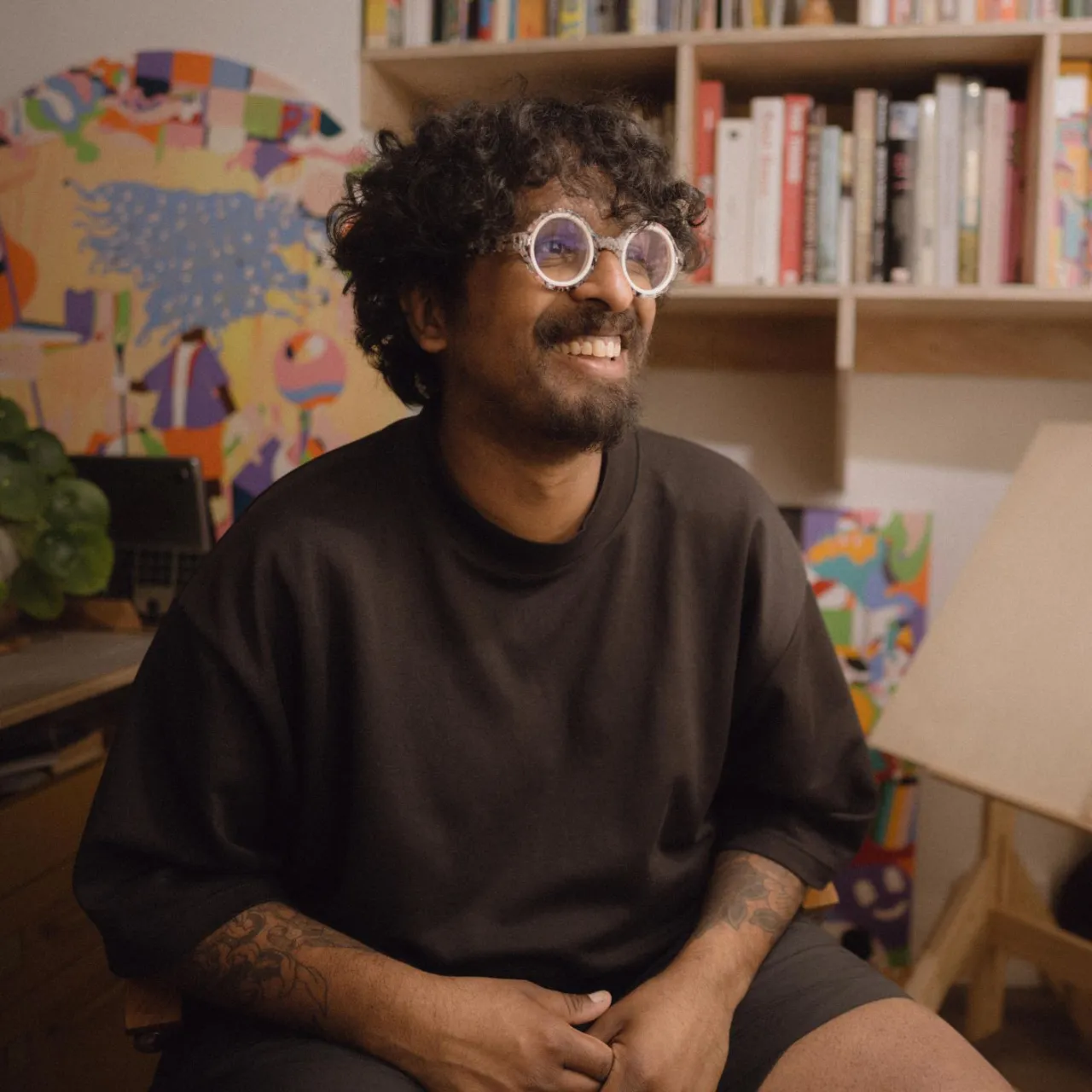
The Parisian artist, who was born in 1992 and has been steadily building a reputation across European art institutions, has a gift for making the serious feel playful, and the playful feel serious. In a cultural moment defined by shouting, he's found a strategy that's remarkably effective: say nothing in particular, very precisely, and let the audience do the work instead. I travelled to the charming city of Reggio Emilia to find out more.
Part one: the live performance
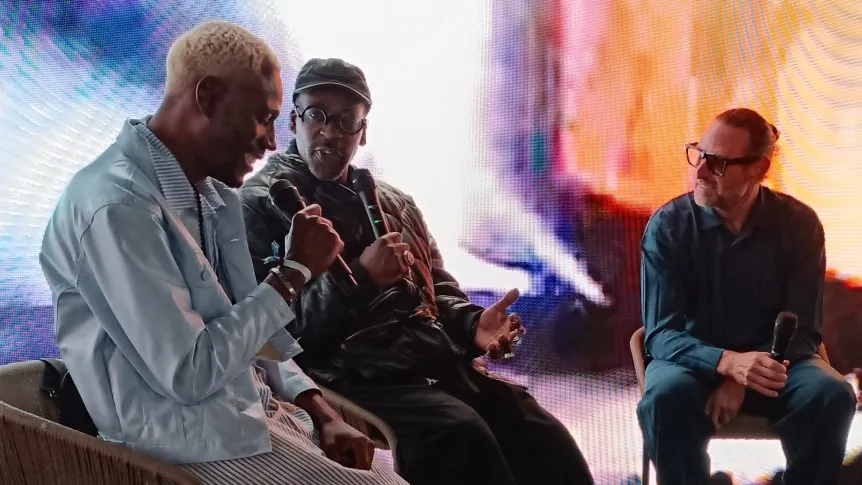
The press preview on Saturday night began not in the galleries but in a separate space, with a live performance art piece titled Please Don't Be, co-presented with a female collaborator. What followed was a 20-minute argument, staged with a healthy dose of irony, about words: what they mean, whether you can combine them, and whether meaning is something that happens to you or something you decide.
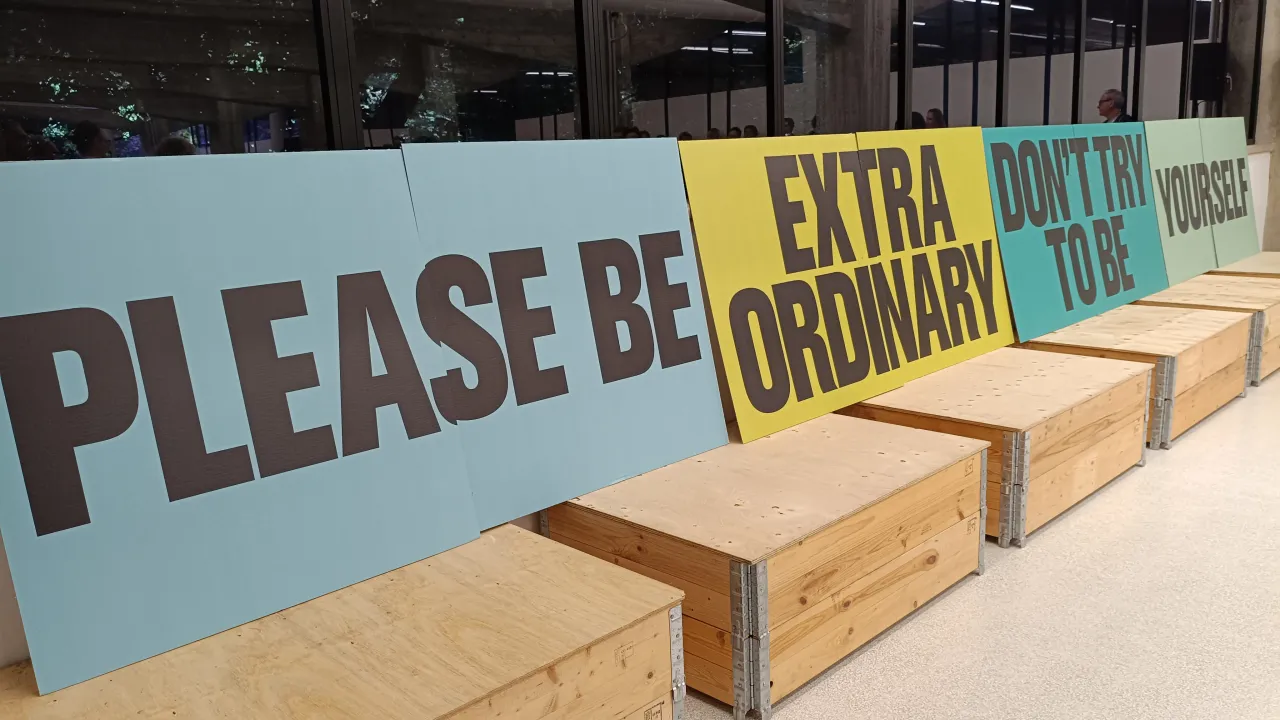
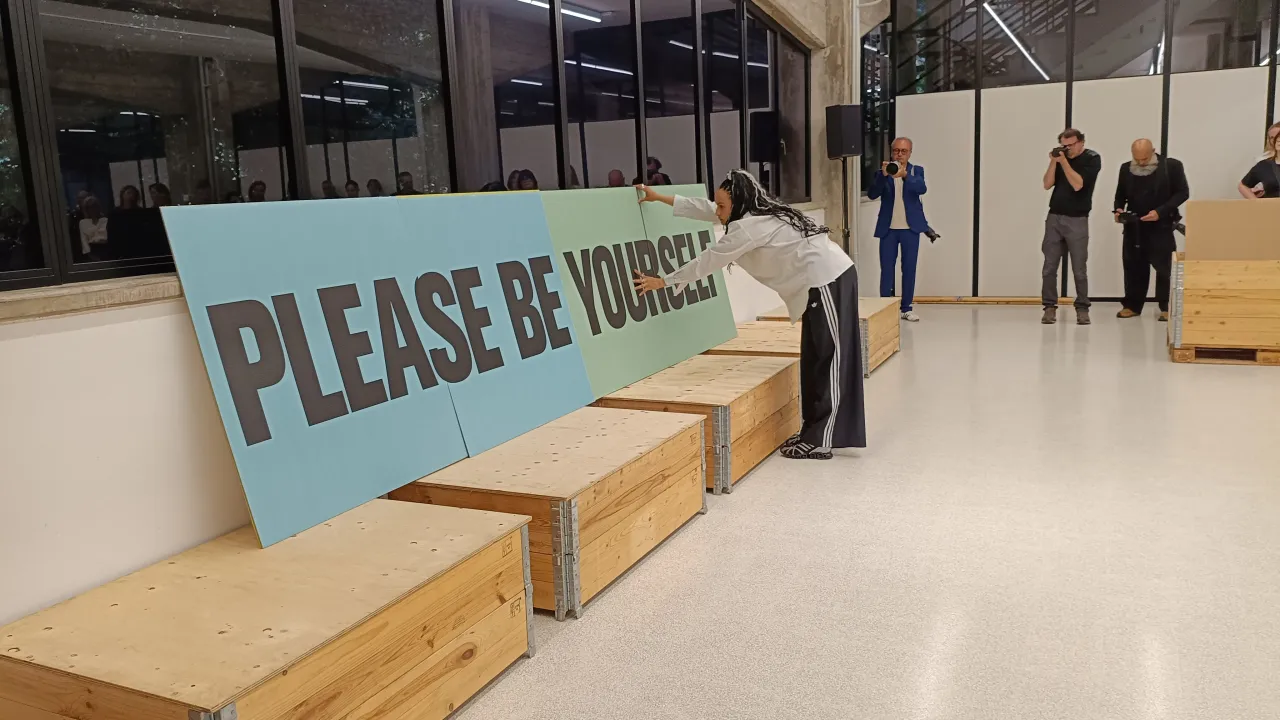
It wasn't just two people talking, though. The two performers moved large, brightly coloured perspex panels printed with individual words, rearranging them on wooden boxes as their debate evolved. At times, the audience was asked to vote with their feet, literally moving to one side of the room or the other.
We were asked to consider questions such as: "Do you think you're extraordinary?" It sounds like a corporate icebreaker; in fact, it was a precise little philosophical exercise about identity, self-perception, and the instability of language. Delivered, most importantly, with enough wit and entertainment that nobody felt lectured at.
Part two: the exhibition
The exhibition occupies a series of rooms in the former Max Mara manufacturing building that now houses the Collezione Maramotti, a foundation-run contemporary art collection with an impressive permanent holding and a strong track record of commissioning emerging artists (Chantal Joffe, Jacob Kassay, Evgeny Antufiev and Jules de Balincourt, to name but a few).
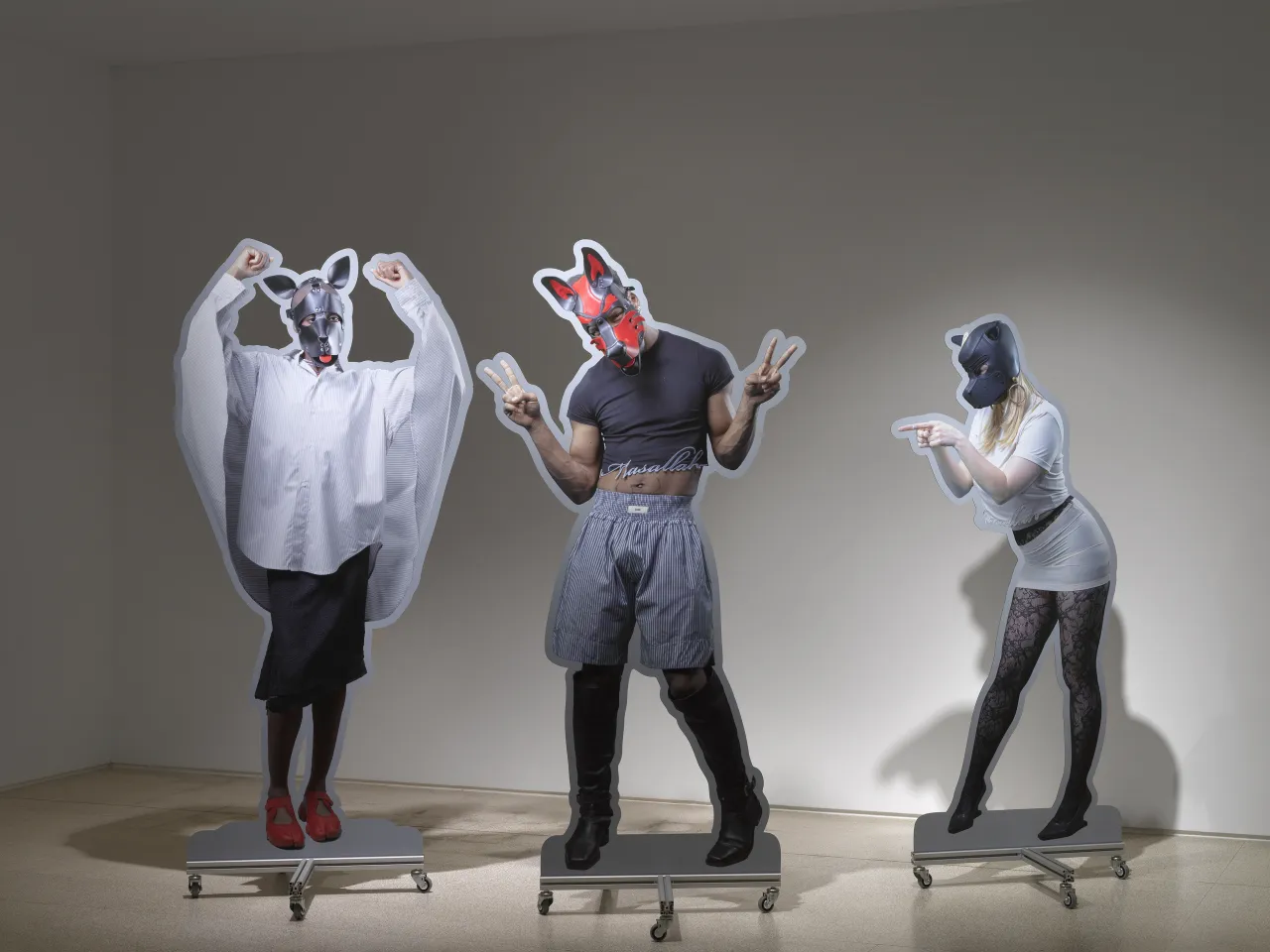
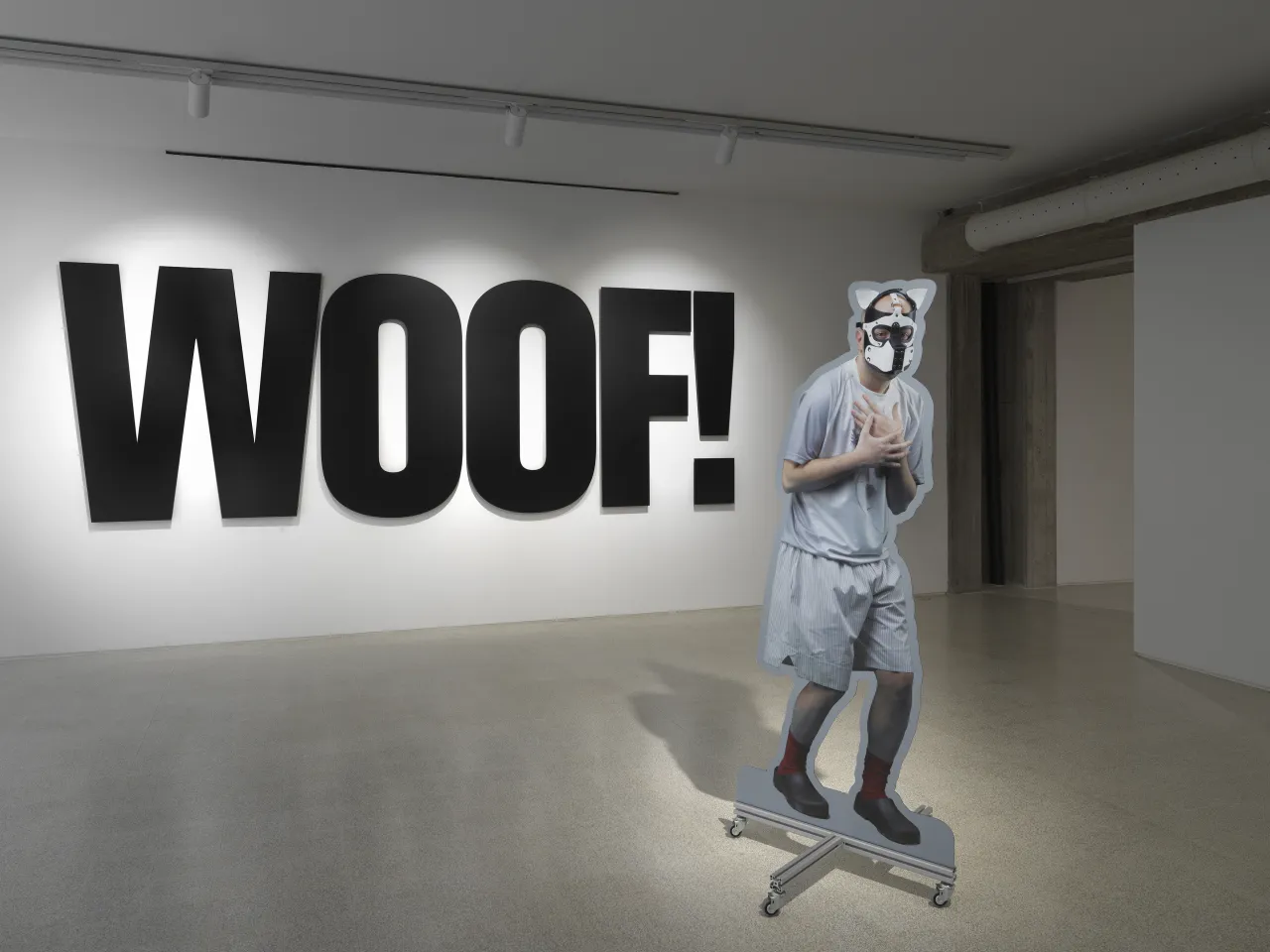
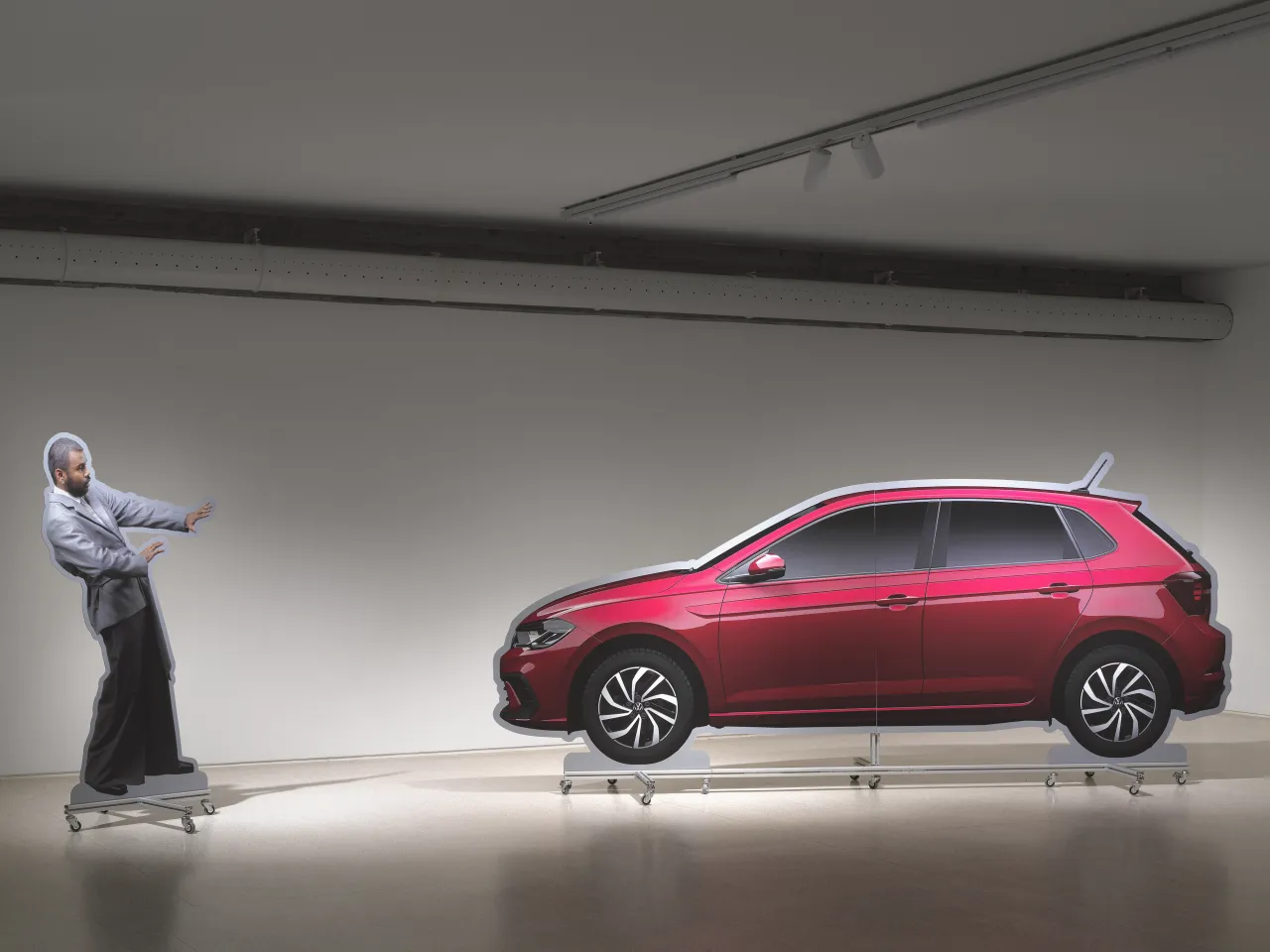
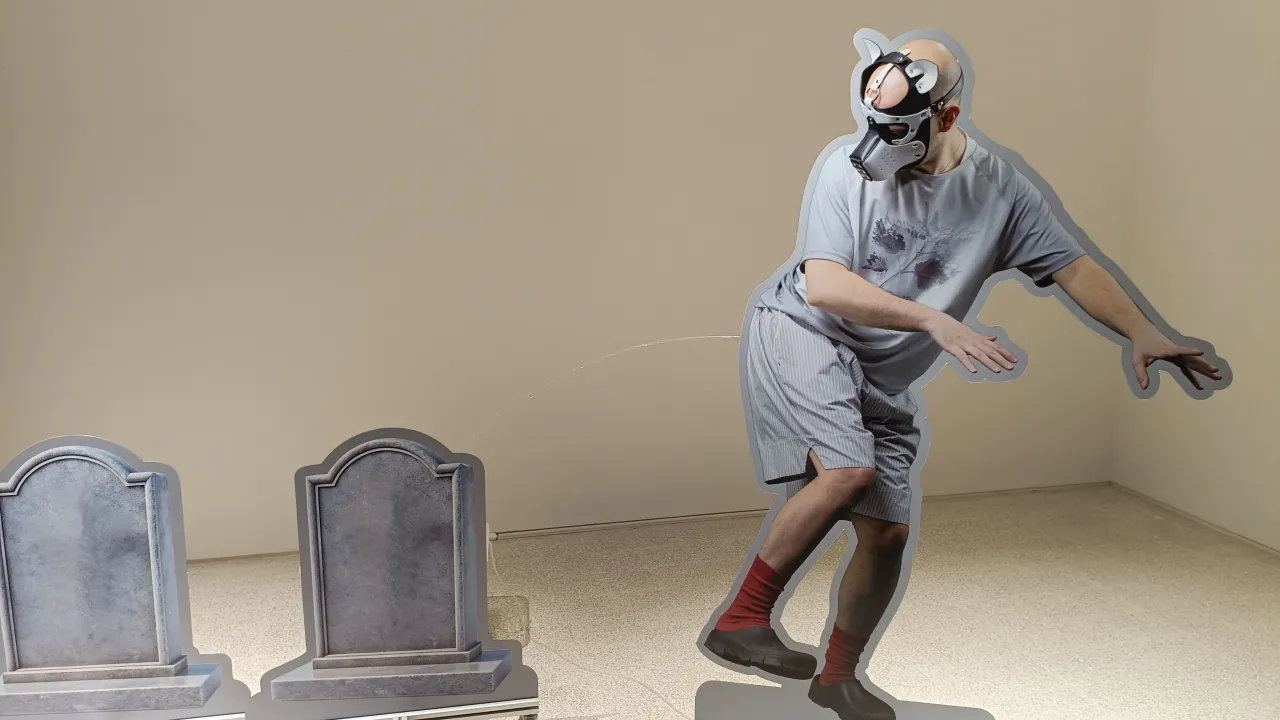
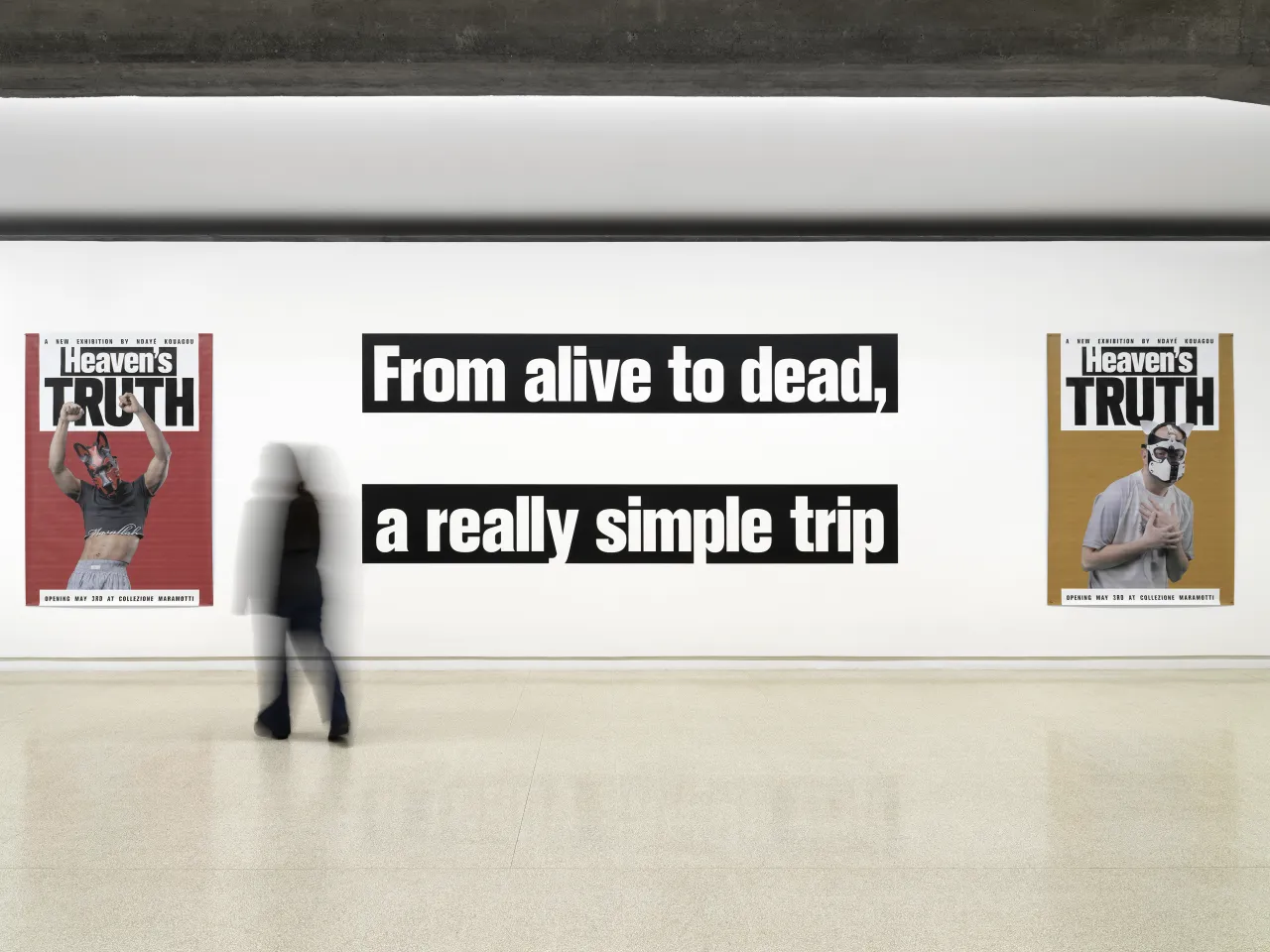
The presentation is ambitious: a multi-room narrative inspired by the fotoromanzo (an Italian photo-comic format), unfolding across video, three-dimensional cutouts, wall pieces and text works. You're introduced, in the first room, to four characters: Pudding, PimPim, Pudha and Pochi. They're represented as life-size photographic cutouts mounted on wheeled steel plinths, each showing a human figure dressed in streetwear and wearing an elaborate fetish-style dog mask.
The effect is somewhere between a fashion shoot, a manga panel and something your browser history would rather not discuss. One figure stands apart, accompanied by a sculptural water feature that represents them urinating. The whole thing is deadpan, precise and weirdly tender.
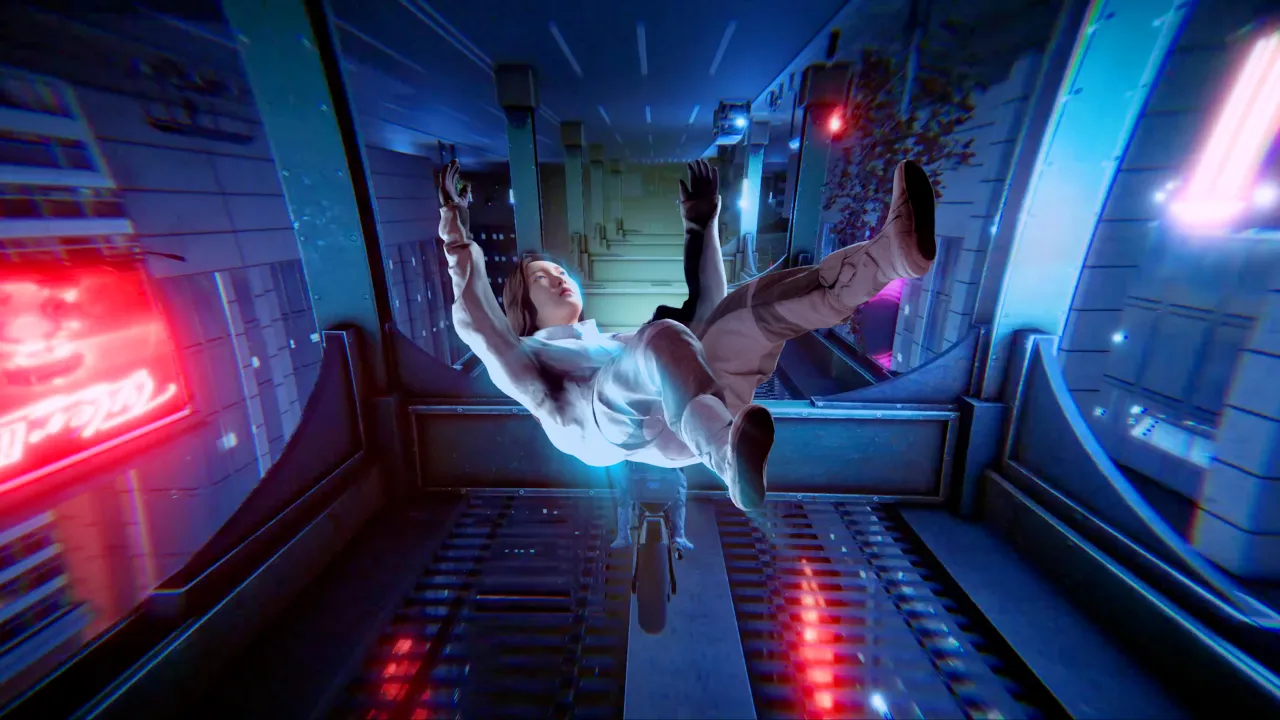
These characters, Ndayé told us, have been part of his performance practice for some time. The video work, divided into three chapters, follows their stories with a woman's voice, dubbed onto the artist's own body—a clever disjunction that turns the figure into "a vessel, not an alter ego," as he put it.
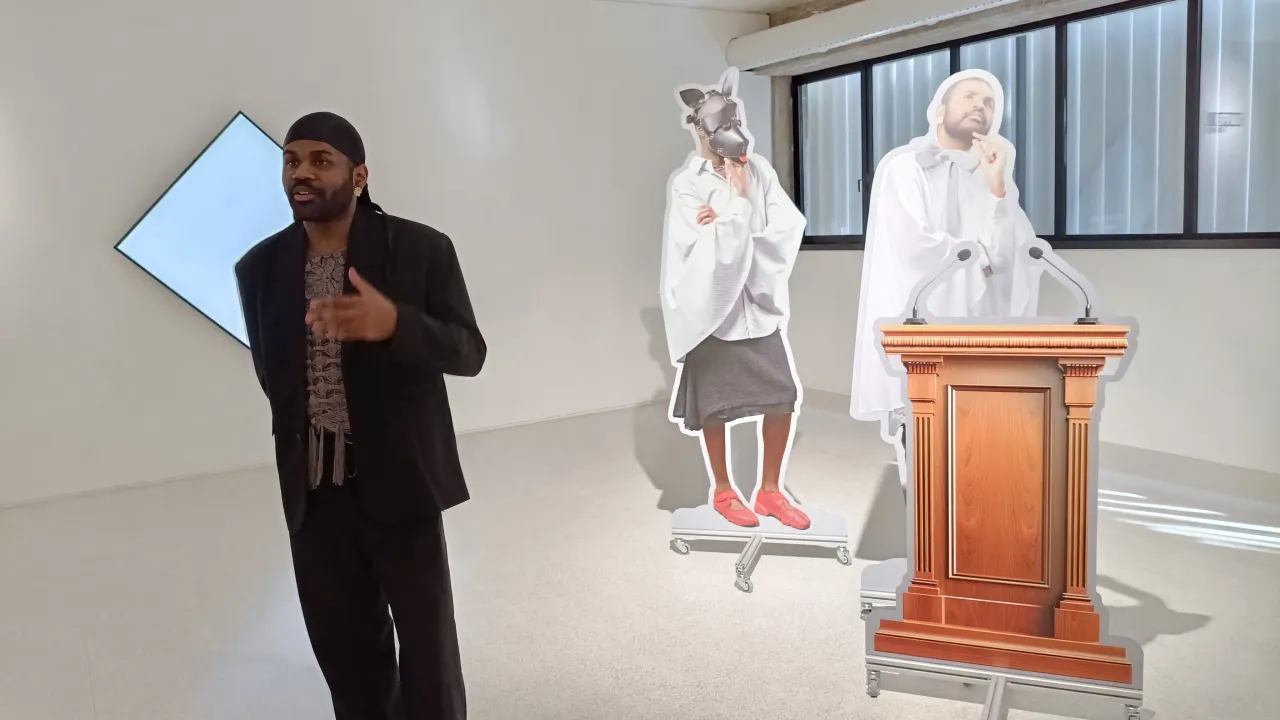
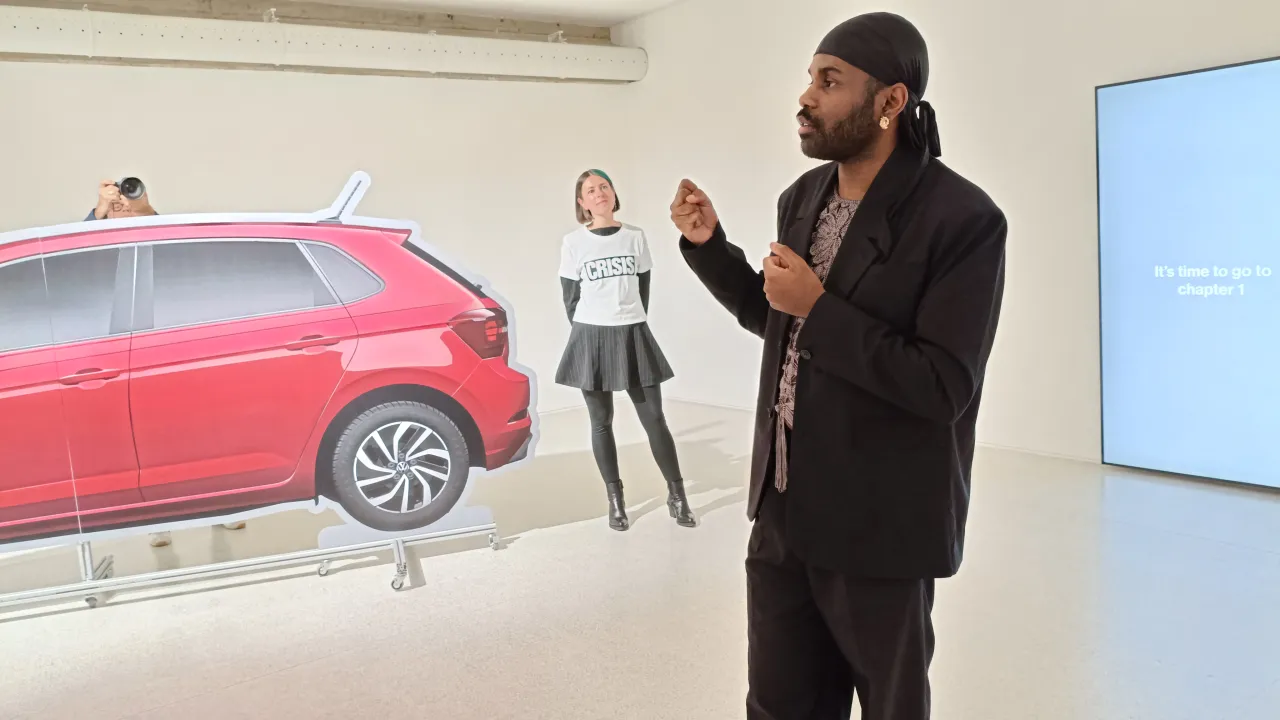
In the third chapter, this character, who has died young, must judge whether Pochi can enter heaven, a task they're not quite equipped for: "they died with the brain not really fully developed". It's an odd tale, but the effect, across rooms one to three, is genuinely touching despite (or perhaps because of) its conceptual scaffolding. It's funny, a little melancholy and structurally smart, leading you through a narrative that keeps shifting its frame of reference.
Breaking news from nowhere
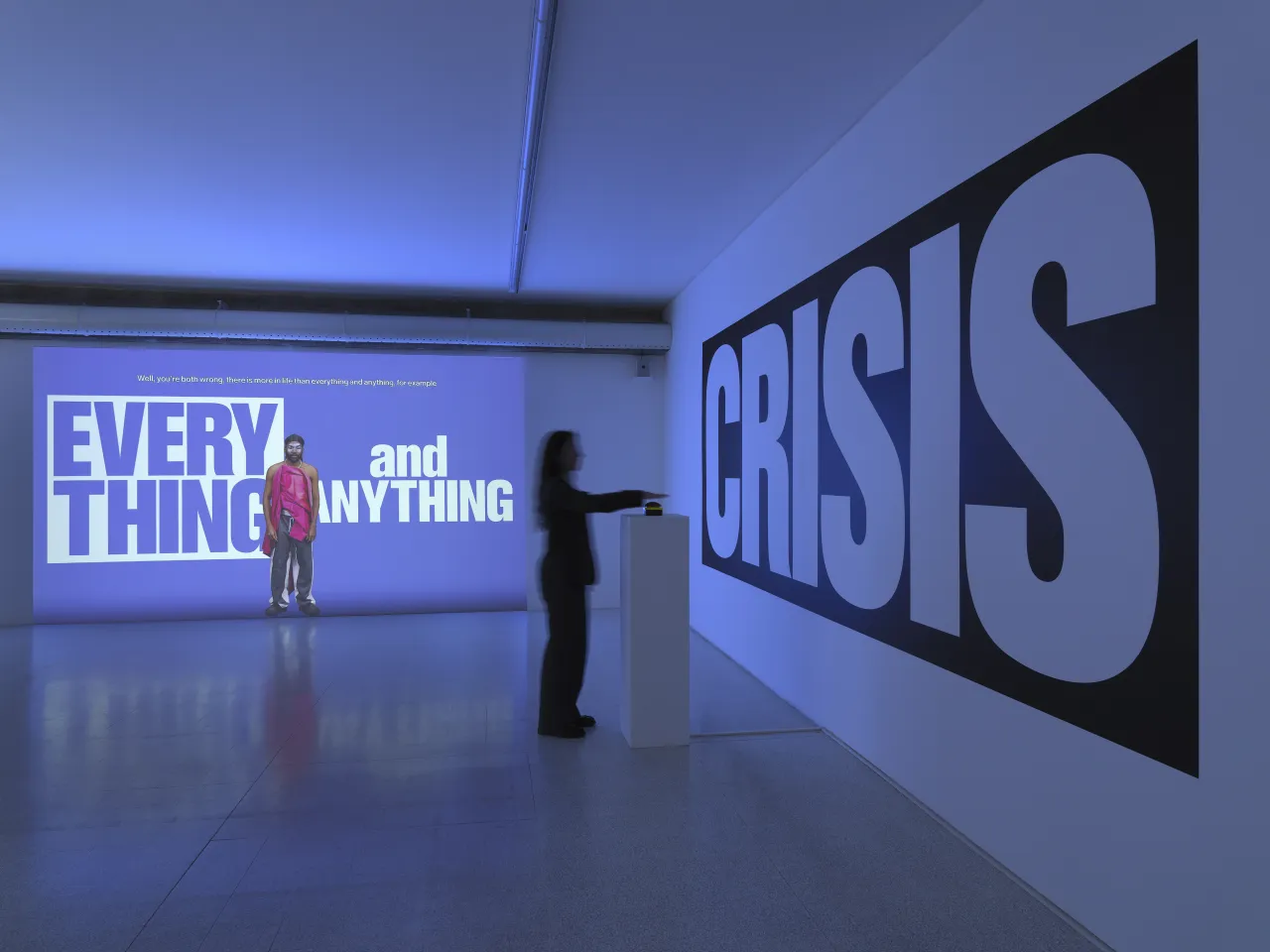
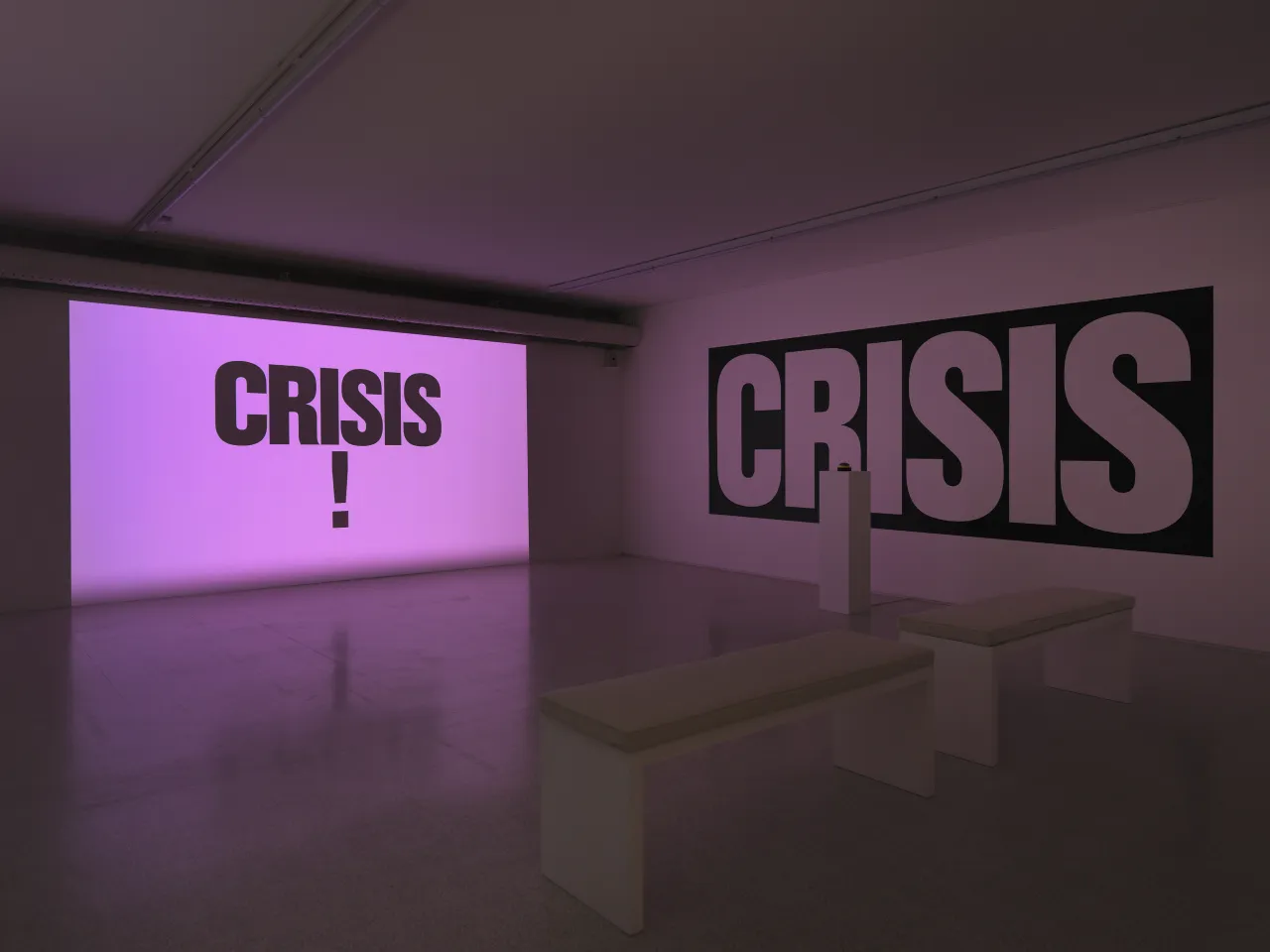
The mood suddenly shifts in room four. A large wall-mounted word, CRISIS, in huge block capitals, dominates the space alongside a video work, Here & Elsewhere (2024), which I feel served as the intellectual anchor of the show.
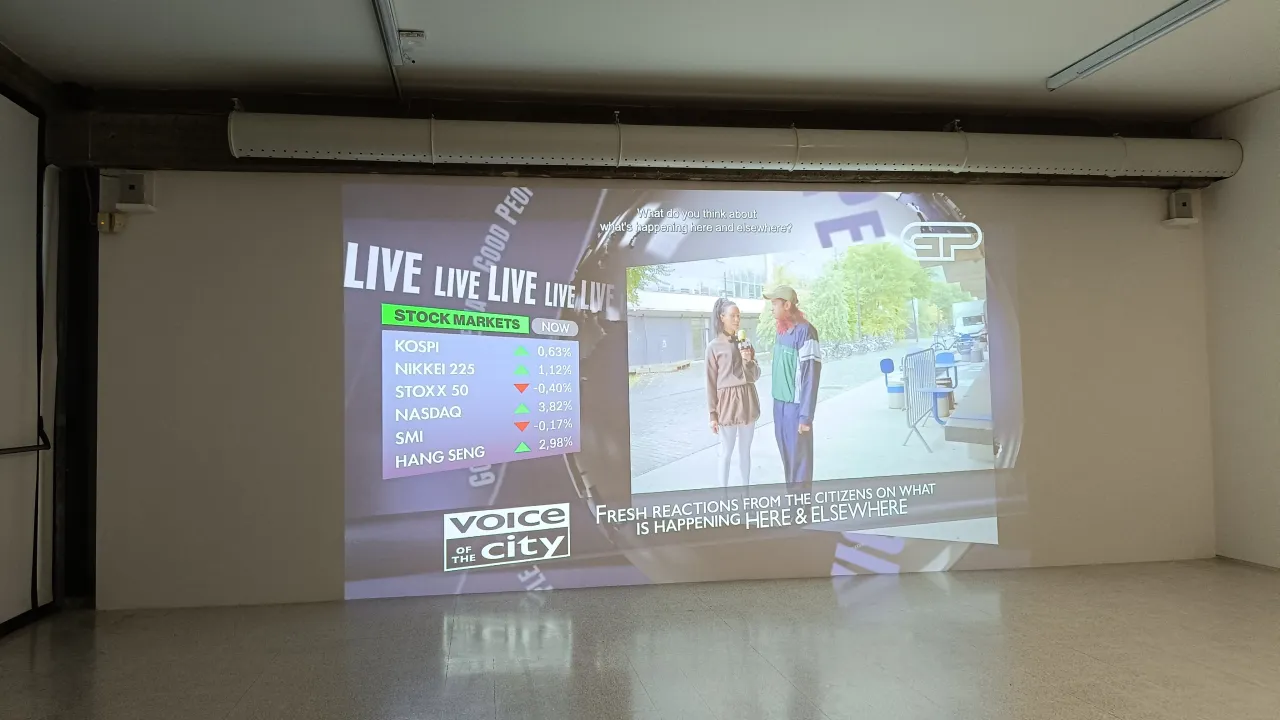
The conceit is simple: a fictitious live news broadcast, complete with stock-market ticker and rolling lower thirds, in which a female reporter conducts vox pops in the street. The question she asks, repeatedly, is: "What do you think about what's happening here and elsewhere?" The responses are equally non-specific.
It's a perfect satirical machine: exposing the circular emptiness of a media culture that prioritises the appearance of engagement over actual content. By extracting every specific reference from the format, Ndayé uncovers the mechanism of polarisation itself, running on empty.
Both sides, all sides, no sides
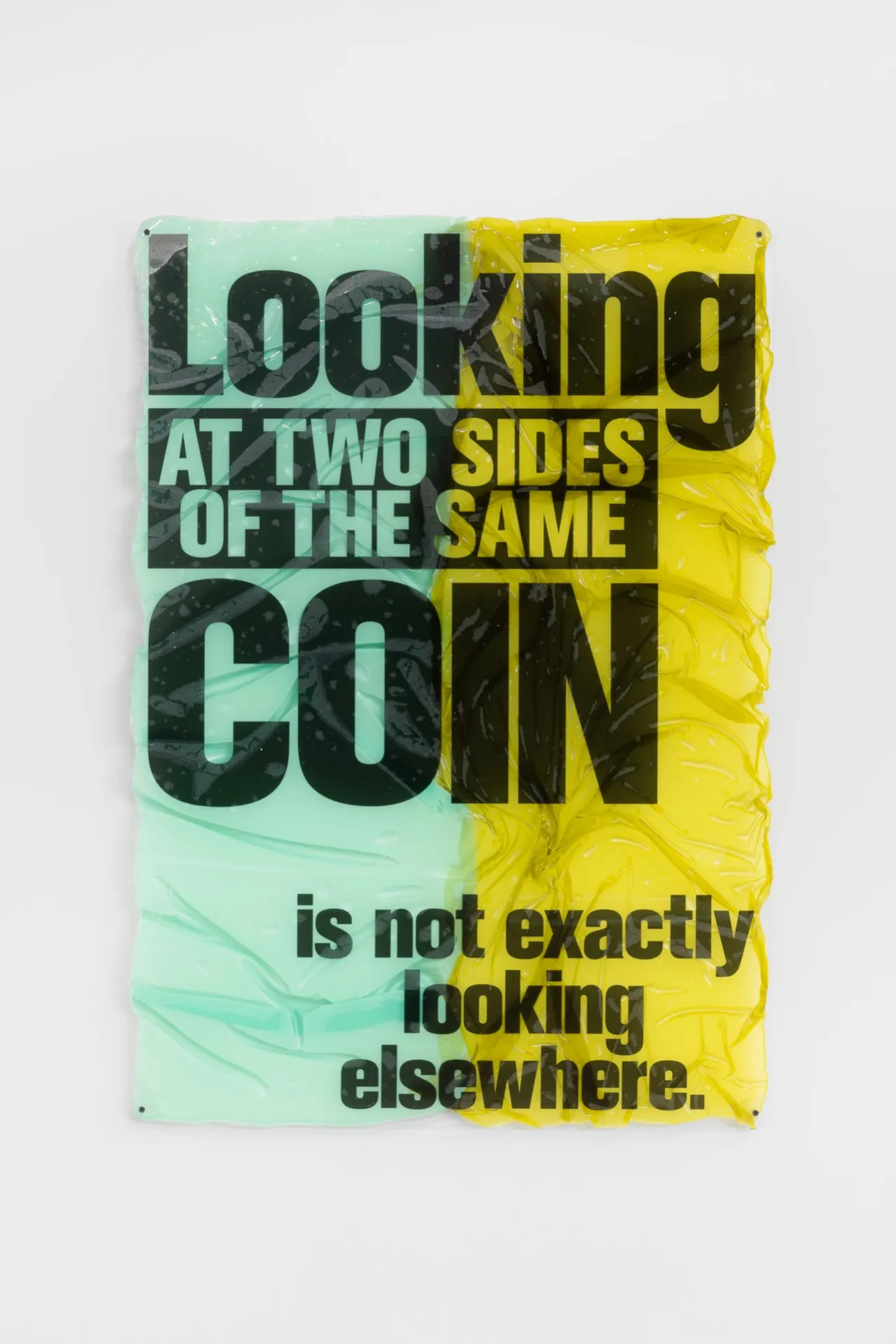
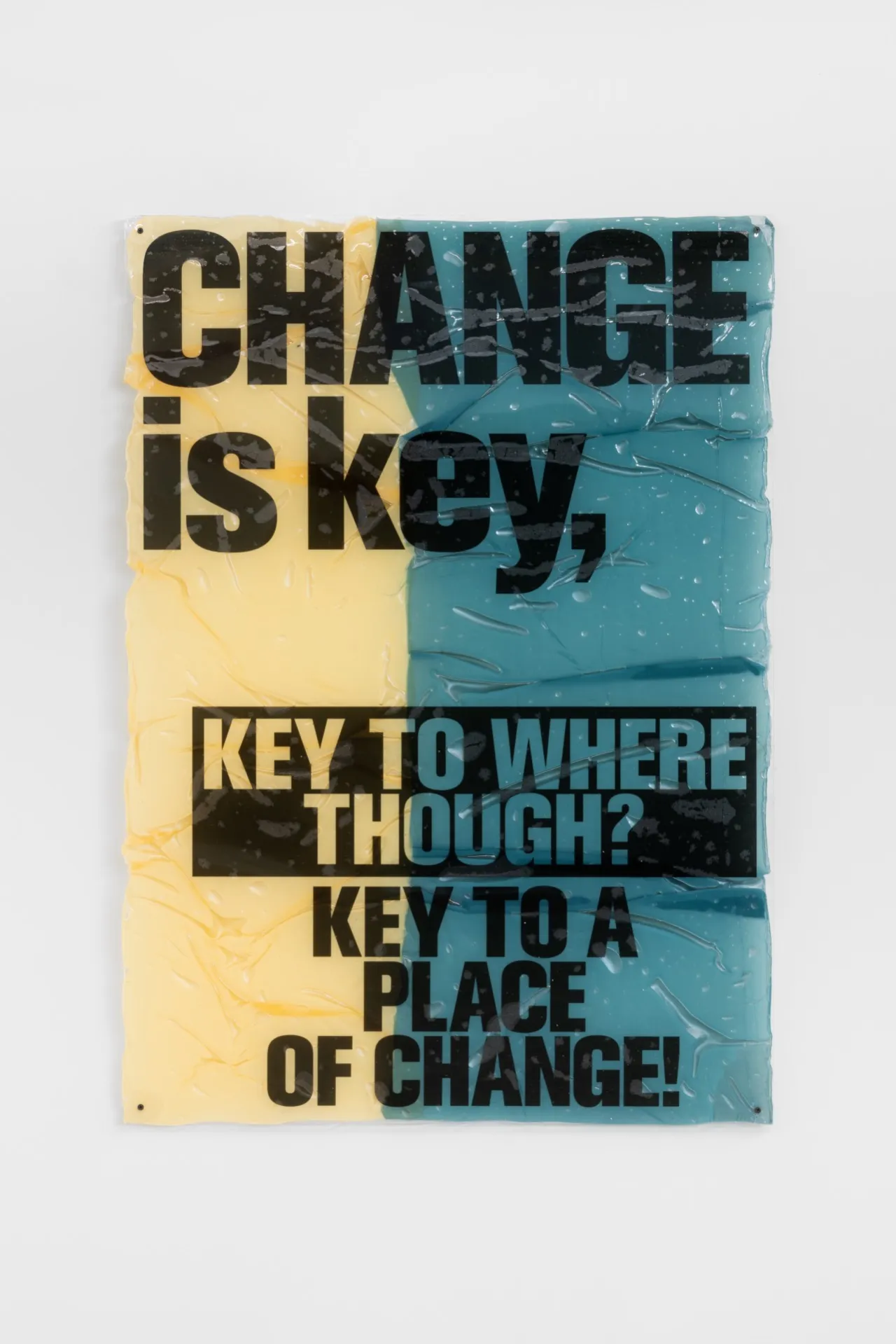
Rooms five and six slow things down again, presenting works from the A Coin Is a Coin series (2022), several of which are already in the Maramotti collection. These large, wrinkled, vaguely banner-like panels are printed with two-tone colour fields and text that interrogates the very metaphor of seeing both sides of an argument.
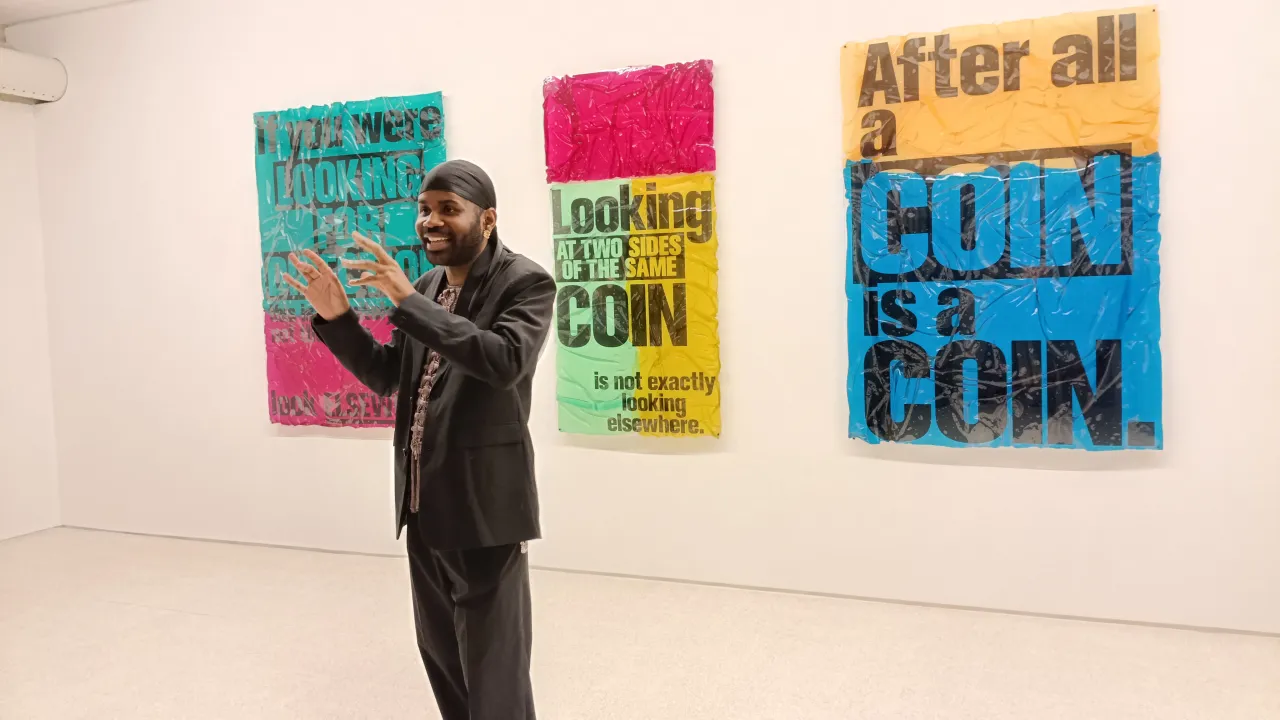
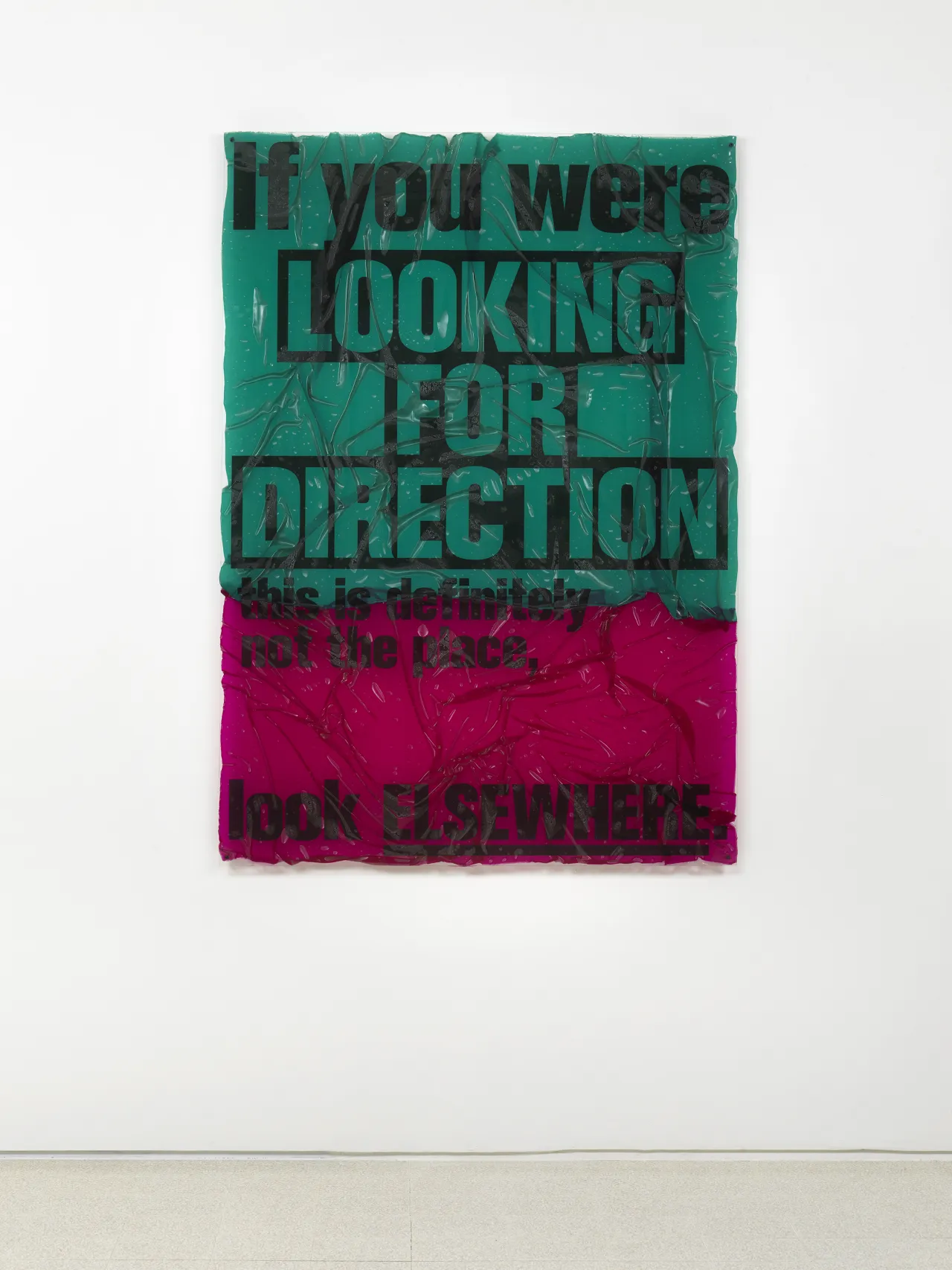
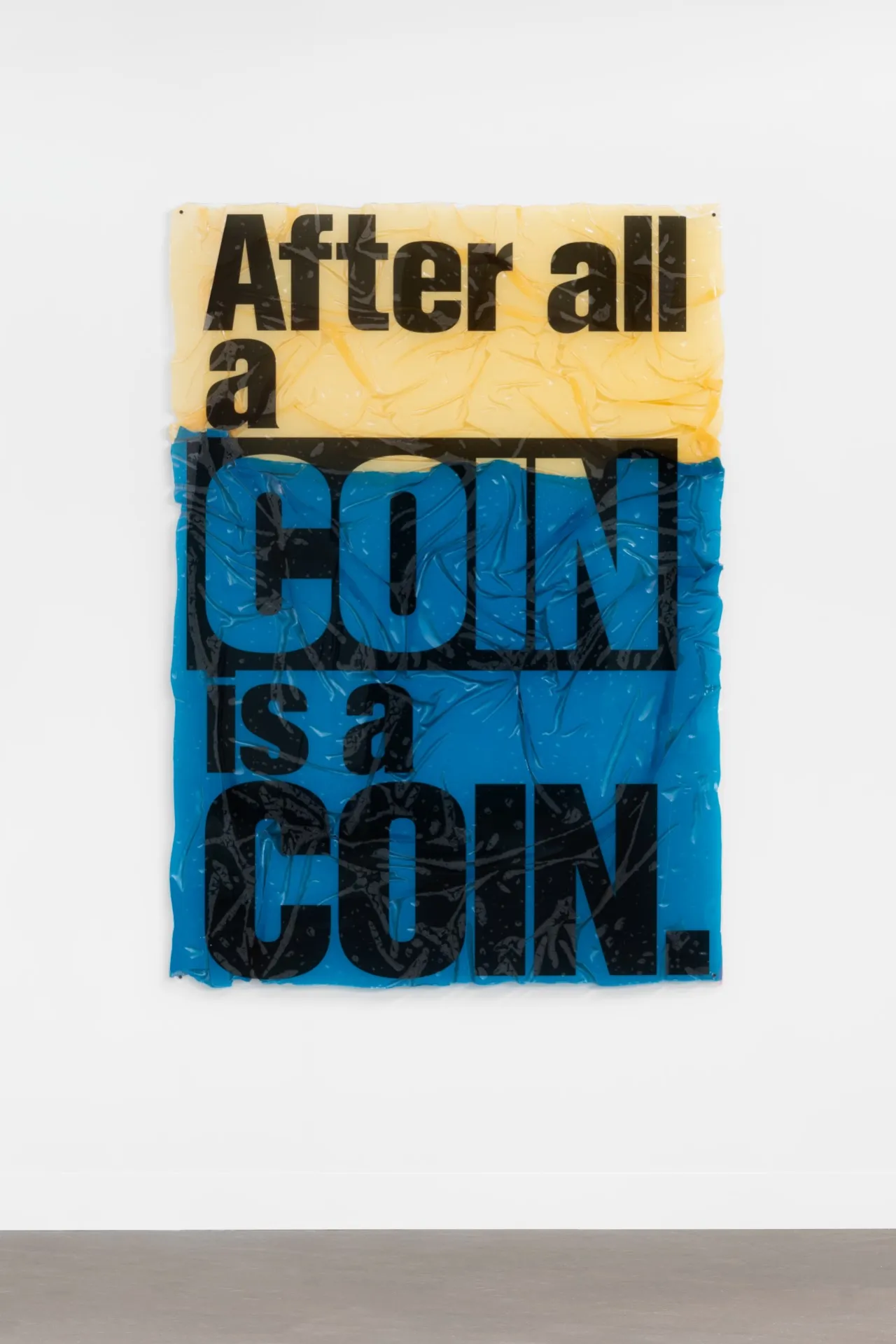
What makes these text works particularly effective is their material quality: the surface is crumpled, translucent in places, resembling a stretched membrane more than a flat sign. They look, in other words, like posters that have been through something. Given their subject matter, that seems about right.
A video monologue develops this further, with Ndayé performing a slow, philosophical dismantling of binary thinking that is both rigorous and gently absurd.
Holding hands through the apocalypse
Ndayé described his approach to exhibition-making with evident self-awareness. "I always want to be as generous as possible," he said. "I want to give them some laughs, some cries, as many emotions as possible." He also described himself, with endearing earnestness, as "an artist who holds your hand" through the show. "Not because I don't believe that you're smart enough to do it yourself, but just because I'm a nice person."
It's a good self-description. The show is carefully calibrated: funny, then serious, then quiet, then cerebral. It trusts the audience without condescending to them. And it makes its point about the mechanics of polarisation by demonstrating them in a safe environment.
Above all, Ndayé isn't offering solutions: all he's doing is creating a space in which people are allowed to think. Heaven's Truth is that space.